
liarjs.dev
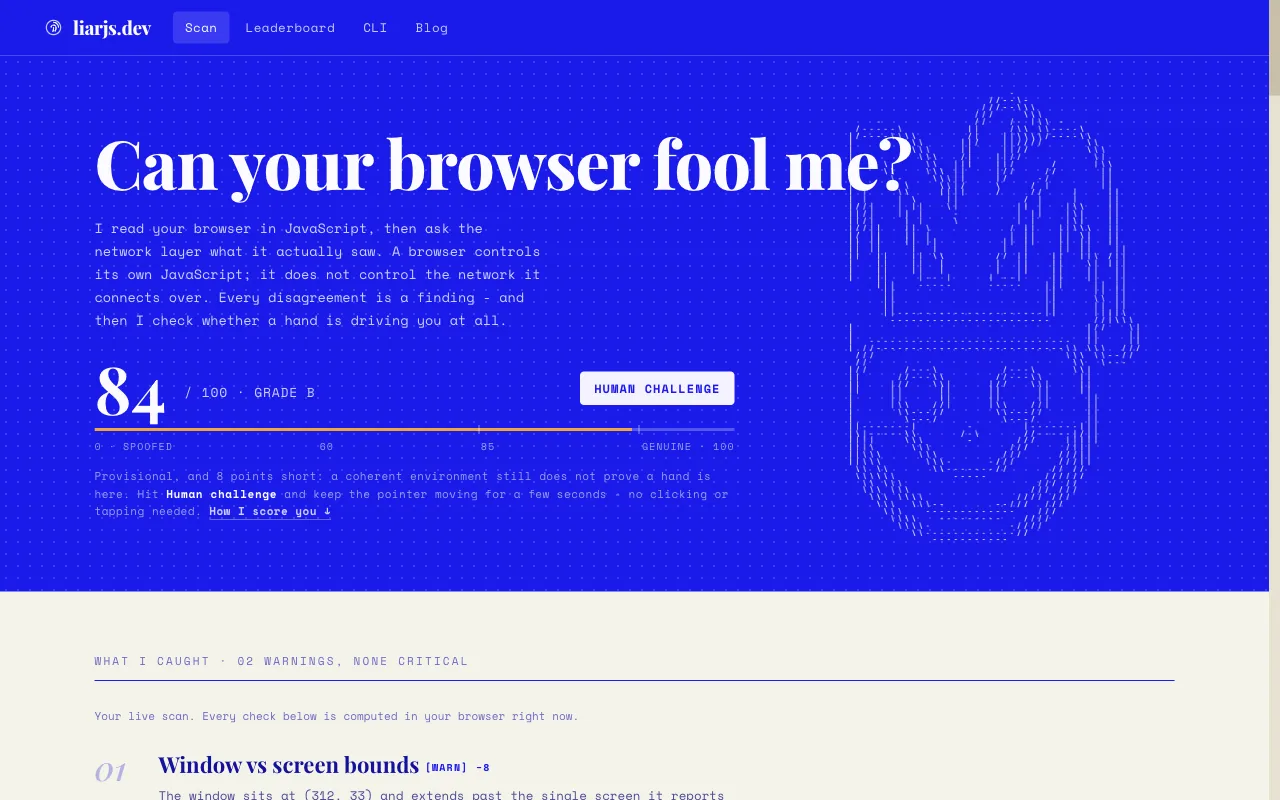
liarjs.dev reads your browser in JavaScript, then asks the network layer what it actually saw. A browser controls its own JavaScript but not the connection it arrives on, so every disagreement between the two is a finding. Detection runs on three separate axes that fail independently. Fingerprint: Canvas, WebGL, WebGPU, audio, fonts, timezone and the plugin face. Network: TLS version, HTTP protocol, ASN, header shape and exit-IP geography, read at the Cloudflare edge. Automation: navigator.webdriver, framework residue, headless tells and a pointer-movement challenge. The score measures internal coherence, not a ban prediction, and stays provisional until the challenge is passed. The passive checks ship as an MIT-licensed npm package: run npx liarjs against a patched Chromium, a stealth automation stack or an antidetect profile and get the same score with an exit code in CI.
Gallery
Alternatives to liarjs.dev
All Testing and QA software tools
Stride
Stride is an AI workspace that connects planning, architecture, process and QA into a single linked graph so updates to one artifact propagate to related work. It provides APIs for coding agents to read a story's full context and open draft pull requests. Modules include planning, design, process optimization, test generation and release gates.

Bytesalt
Bytesalt is an AI-powered QA platform that automates functional, UI, API, accessibility, penetration, cross-browser, and cross-device testing. It accepts web app or API endpoints and credentials to generate and run test suites, reducing manual QA time from weeks to minutes.